
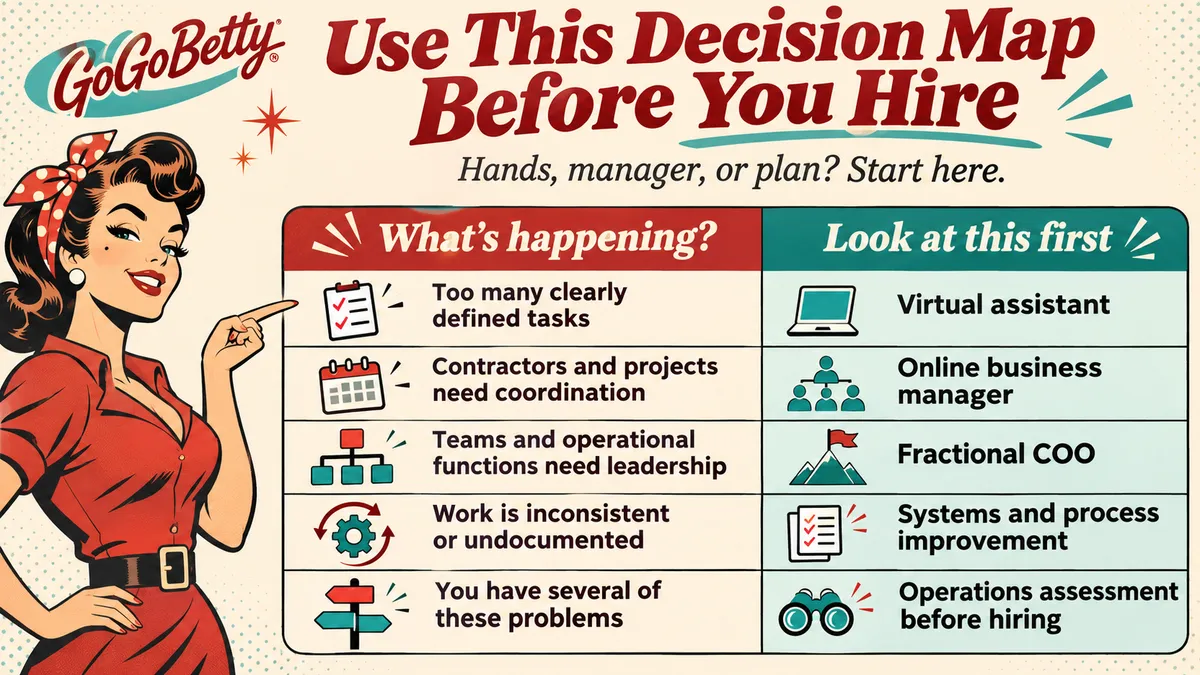
VA vs. OBM vs. Fractional COO: How Small Businesses Choose
VA, OBM, Fractional COO, or Systems First? How to Choose When Your Business Is Small.
You've reached the point where you know you need help.
Your calendar is packed. You're answering questions that someone else should be able to answer. Projects don't move unless you check on them, and you're spending more time managing the details than running the business.
So you start looking for help.
And suddenly you're comparing virtual assistants, online business managers, fractional COOs, and consultants who promise to fix your operations.
Who knew getting something off your plate would require so much extra work?
Before you hire anyone, there's a much simpler question worth answering.
What's actually missing from your business: hands, a manager, or a plan?
You need hands when the work is clear, but there's too much of it
A virtual assistant (VA) is often a good fit when you know what needs to happen and how it should be done, but you don't have enough hours to do it yourself.
Think calendar management, inbox organization, scheduling, data entry, document preparation, and repeatable administrative tasks.
The key word is repeatable.
If you can explain the task, identify what a good result looks like, and give someone the access they need, there's a reasonable chance you can hand it over.
But here's where founders get frustrated.
They hire a VA, provide very little direction, and expect that person to somehow figure out the business along the way.
A great assistant can solve plenty of problems. Reading your mind shouldn't be one of the job requirements.
You probably need hands if:
You're doing the same administrative tasks every week.
The process works, but you don't have time to keep doing it.
You can describe what needs to happen and when.
You need consistent execution more than strategic direction.
You need a manager when the work has too many moving parts
An online business manager (OBM) generally works at a different level.
Instead of focusing primarily on individual tasks, an OBM helps coordinate ongoing operations, projects, people, and deadlines.
Consider a business with a website project underway, two contractors, an active client roster, and a marketing calendar.
Someone needs to make sure the work moves forward, the right people have the information they need, and problems are addressed before they become emergencies.
If that someone is always you, there's a management gap.
An OBM may be an appropriate solution when you have established work to coordinate but don't want to remain its full-time traffic controller.
You probably need a manager if:
You have contractors or team members who need coordination.
Work routinely stalls while everyone waits for your input.
Multiple projects compete for attention.
You need someone to own follow-through, not merely complete assigned tasks.
Titles aren't standardized, and some OBMs provide substantial strategic support. Evaluate the actual responsibilities, authority, and experience rather than the job title alone.
You need operational leadership when the business needs a better way to run
A fractional Chief Operating Officer (COO) typically works with the owner on higher-level operational strategy.
That can include team structure, management accountability, operating priorities, performance measures, and decisions about how a growing business should function.
This level of support becomes more valuable when there's already a team, established revenue, and operational complexity to manage.
For a small founder-led business, a fractional COO may be more support than the business currently needs.
Or it may be exactly the right fit.
The deciding factor isn't whether the title sounds impressive. It's whether the complexity of the business justifies that level of leadership.
You may need fractional operational leadership if:
You're managing multiple functions or teams.
Operational problems are affecting profitability or growth.
You need someone to help design and oversee company-wide improvements.
The business has enough scale to support an ongoing leadership role.
Sometimes you need a plan before you need another person
This is the option that gets overlooked.
Let's say every new client goes through a slightly different onboarding process.
Sometimes you send a welcome email. Sometimes you forget until the next morning. Contracts live in one platform, invoices in another, and the information needed to begin the work is scattered across emails and notes.
Hiring someone to manage that process could help.
But what process are you asking them to manage?
Before adding another person, consider whether you need to define how work should move through the business.
That might include documenting a few recurring processes, clarifying who makes decisions, creating a simple project-tracking system, or connecting tools you're already paying for.
You don't need an elaborate operations manual for every task.
You need enough structure that the next person isn't forced to invent the rules as they go.
Systems first may be the right move if:
Every task seems to require a new explanation.
Information is scattered across people and platforms.
Your tools aren't working together.
Nobody, including you, can clearly explain what happens next.
You suspect hiring someone would simply give you another person to manage.
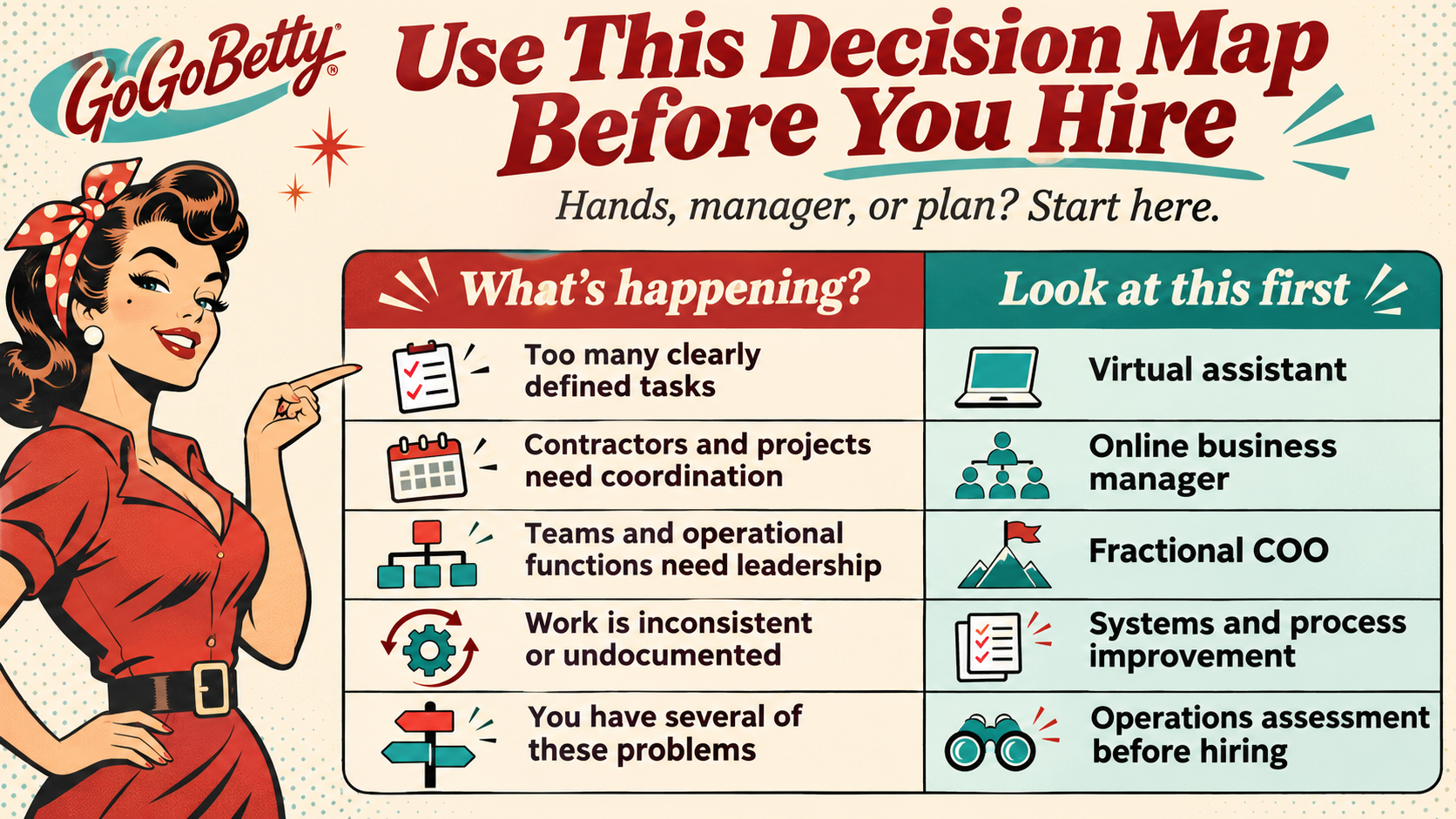
These aren't mutually exclusive choices. An experienced operations partner may combine strategy, systems implementation, and ongoing management.
What matters is making sure the work you're paying for matches the problem you're trying to solve.
What should you hand off first?
Choose one recurring task and ask:
Does this task happen often enough to justify handing it over?
Can I explain what a successful result looks like?
If someone makes a mistake, can we correct it without serious consequences?
What decisions should still require my approval?
Start with work that is easy to explain and relatively low-risk.
For anything involving money, sensitive information, important client communication, or public-facing commitments, establish clear approval boundaries before handing over responsibility.
And resist the temptation to document everything in a single weekend. Start with the processes that cause the most friction or are about to be delegated.
Where GoGoBetty fits
Sometimes you don't need a full-time operations hire. You need an experienced person to look at how the business currently works, identify what's getting in the way, and help put better systems in place.
That's the work behind GoGoBetty.
The Organize Sprint is a focused six-week engagement for improving operational processes and systems. The Boss Betty Retainer provides ongoing fractional operations and strategic support.
Both are designed around the same goal: making your business less dependent on you for every little decision.
Because hiring help should actually help.
Not sure whether you need hands, a manager, or a better plan?
Make Good Choices!
xo, Betty 💋


